Setup Network Printer Windows Server 2008 R2
Posted By admin On 08.08.19
Applies To: Windows 7, Windows Server 2008 R2
You can use the Print Management snap-in to automatically detect all the printers that are located on the same subnet as the computer on which you are running Print Management, install the appropriate printer drivers, set up the queues, and share the printers.
To add a printer by IP address or hostname, you must be a member of the local Administrators group or be granted the Manage Server permission.
To automatically add network printers to a print server
The Printers preference extension allows you to create, configure, and delete TCP/IP printers by using the TCP/IP Printer preference item. Before you create a TCP/IP Printer preference item, you should review the behavior of each type of action possible with the extension. Mar 26, 2014. To add print servers to Print Management. Open the Administrative Tools folder, and then double-click Print Management. In the Print Management tree, right-click Print Management, and then click Add/Remove Servers. In the Add/Remove Servers dialog box, under Specify print server, in Add server, do one of the following. Windows Server 2008 Auto detecting and installing a USB printer. Once the printer has been installed, it will likely need to be configured for network sharing. To achieve this, launch the Print Management tool, select the print server to which the printer is physically.
Open Print Management.
In left pane, click Print Servers, click the applicable print server, right-click Printers, and then click Add Printer.
On the Printer Installation page of the Network Printer Installation Wizard, click Search the network for printers, and then click Next. If prompted, specify which driver to install for the printer.
Note
To add printers that are on the same subnet as a remote print server, use Remote Desktop to log on to the print server, open Print Management and then add the printer.
Additional considerations
To open Print Management, click Start, point to Administrative Tools, and then click Print Management.
If you are a member of the local Administrators group, you can grant someone else the Manage Server permission to be able to add a printer by IP address or hostname. To do this, open Print Management, double-click Print Servers, right-click the applicable print server, and click Properties. On the Printer Server Properties dialog box, click the Security tab, select the user from the list, click the Manage Server check box under Allow, and then click OK.
If the Print Management snap-in is not available because the Print Server role service is not installed on this server, you must have administrative privileges to be able to add a printer by IP address or hostname. While in the Add Printer Wizard, select Add a local or network printer as an administrator and follow the instructions in the Add Printer Wizard to add a printer using administrative privileges.
To add Web Services for Devices (WSD) printers for sharing and to view them on your network, network discovery must be enabled and the PnP-X IP Bus Enumerator service must be running. To add a WSD printer, you must be a member of Administrators group.
To enable network discovery, click Start, click Control Panel, and then click Network and Internet. On the Network and Internet page, click Network and Sharing Center. On the Network and Sharing Center page, click Change advanced sharing settings. On the Advanced sharing settings page, Click the arrow next to Domain, click turn on network discovery, and then click Save changes.
To start the PnP-X IP Bus Enumerator service, Click Start, click Administrative Tools and then click Services. In the center pane, right-click PnP-X IP Bus Enumerator and then click Start.
Additional references
This section describes how to install the printer driver using the Standard TCP/IP port.
The Manage Printers permission is required to install the drivers. Log on as an Administrators group member.
There are times a Windows warning message may appear during the installation. Disregard the message and continue the installation.
Close all applications except this manual.
Double click the downloaded file and unzip it at an easily accessible location.
Open the window for configuring printers. For details, see your operating system's Help.
Click [Add a printer] or double click the [Add Printer] icon.
Under Windows Vista/7 and Windows Server 2008/2008 R2, proceed to step 7.
Click [Local printer attached to this computer], and then click [Next].
Under Windows Vista/7 and Windows Server 2008/2008 R2, click [Add a local printer].
Adding Network Printer Windows Server 2008 R2
Select [Standard TCP/IP Port] and then click [Next].
Under Windows Vista/7 and Windows Server 2008/2008 R2, proceed to step 11.
Click [Next] in the [Add Standard TCP/IP Printer Port Wizard] window.
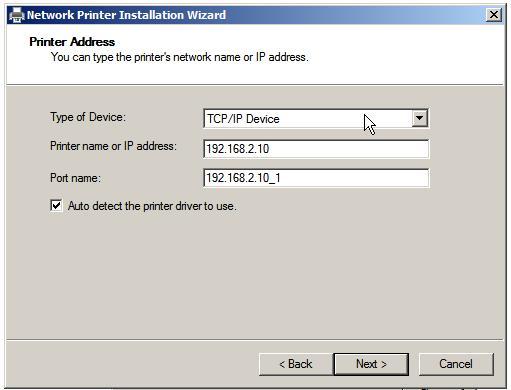
Enter the printer name or IP address in the [Printer Name or IP Address] or [Hostname or IP address] box, and then click [Next] .
The [Port Name] text box automatically obtains a port name. Change this name if necessary.
When the screen for selecting the device type appears, select 'RICOH Network Printer C model'.
Under Windows Vista/7 and Windows Server 2008/2008 R2, proceed to step 13.
Click [Have Disk...].
Setting Up Network Printer Windows Server 2008 R2
Click [Browse...], and then specify the location where the source files of the printer driver are saved.
In the [Disk1] folder, specify the INF file.
Click [OK] to close the [Install From Disk] window.
Make sure the brand name and model name of the printer whose driver you want to install are selected, and then click [Next].
Follow the instructions that appear. Modify settings such as the printer name, default printer, and printer sharing configuration as necessary. You can also print the test page.